Infinite Combo Commander Deck Maker | Analyze Power Level, Legality & Upgrades
Your deck has more combos than you think — and probably fewer than you need
You built the list. You shuffled it up. You lost on turn 4 to a Thassa’s Oracle line and realized you weren’t even close to assembling your own win. (efficiently maximize a win rate, rulings, logistics of each keywords,
Most Commander players massively overestimate how many real combo lines their 99 actually contains. They count Kiki-Jiki and forget they cut the only haste-enabler that made him work. They run Underworld Breach with no LED and no Brain Freeze. They build decklists by vibes and find out at the table.
The fix is not another deck. It’s seeing what you already have — every two-card kill, every infinite mana loop, every orphan piece sitting alone with no partner — and pruning until what’s left is sharp.
Quick answer
The combo analyzer at mtgcombotrainer.com/analyze takes any Commander or cEDH decklist, identifies every infinite combo and two-card kill present in the 99, flags legality issues and color-identity violations, and suggests upgrades based on what’s missing. Paste a Moxfield list or 100 card names. Results in under ten seconds. Free.
What the analyzer actually checks
The tool runs four passes against your decklist. Each one answers a question most players never bother to ask out loud.
Combo coverage. Every infinite combo and two-card kill present in your list, sourced from live Commander Spellbook data. If your deck contains Isochron Scepter and Dramatic Reversal but not enough non-land mana to go infinite, you’ll see that. If you have Heliod and Walking Ballista but no tutors that can reach both, you’ll see that too.
Legality and color identity. Banned cards. Cards outside your commander’s color identity. Cards in the wrong format. The kinds of mistakes that get noticed in round one of a tournament and at no point sooner.
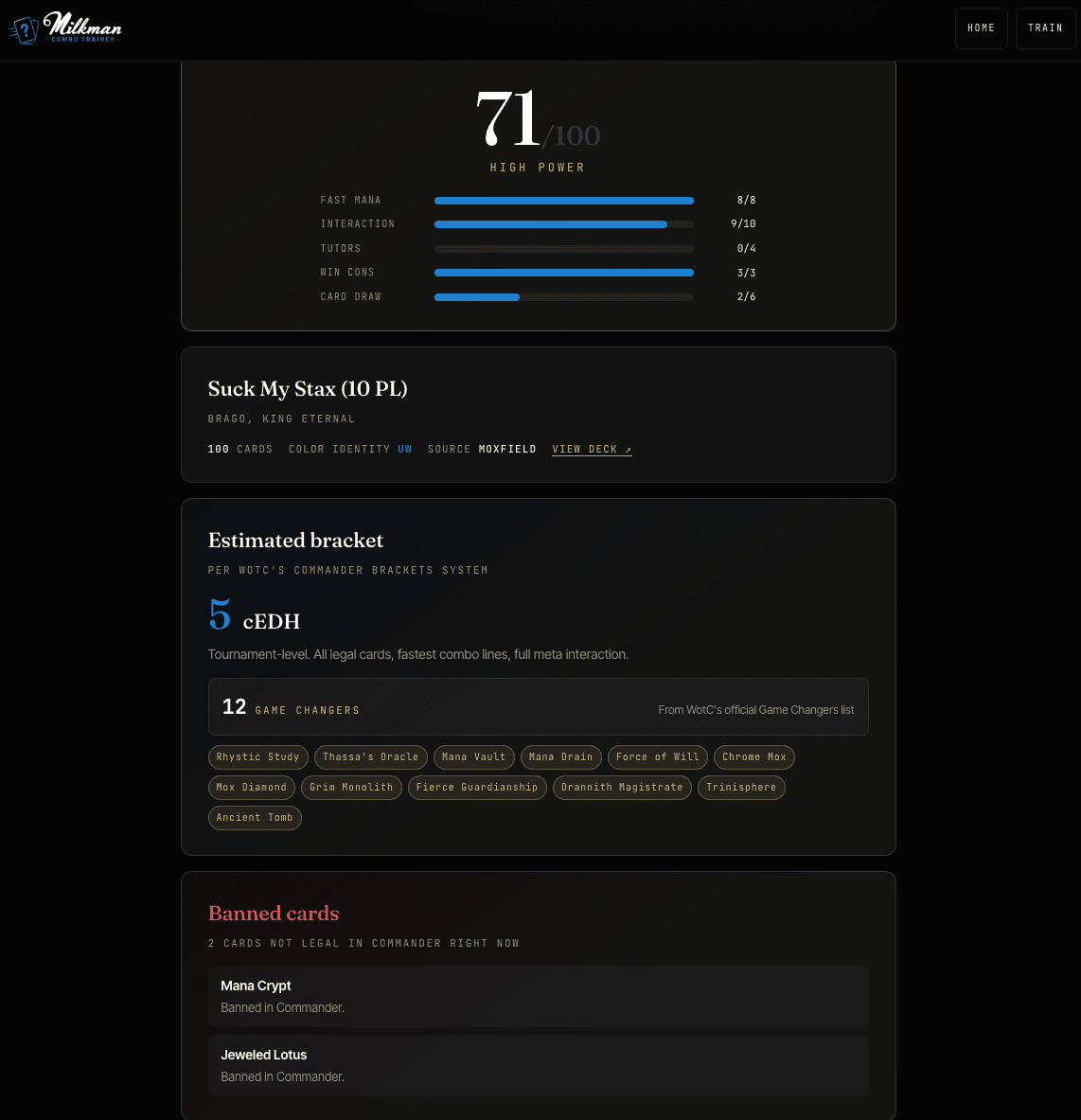
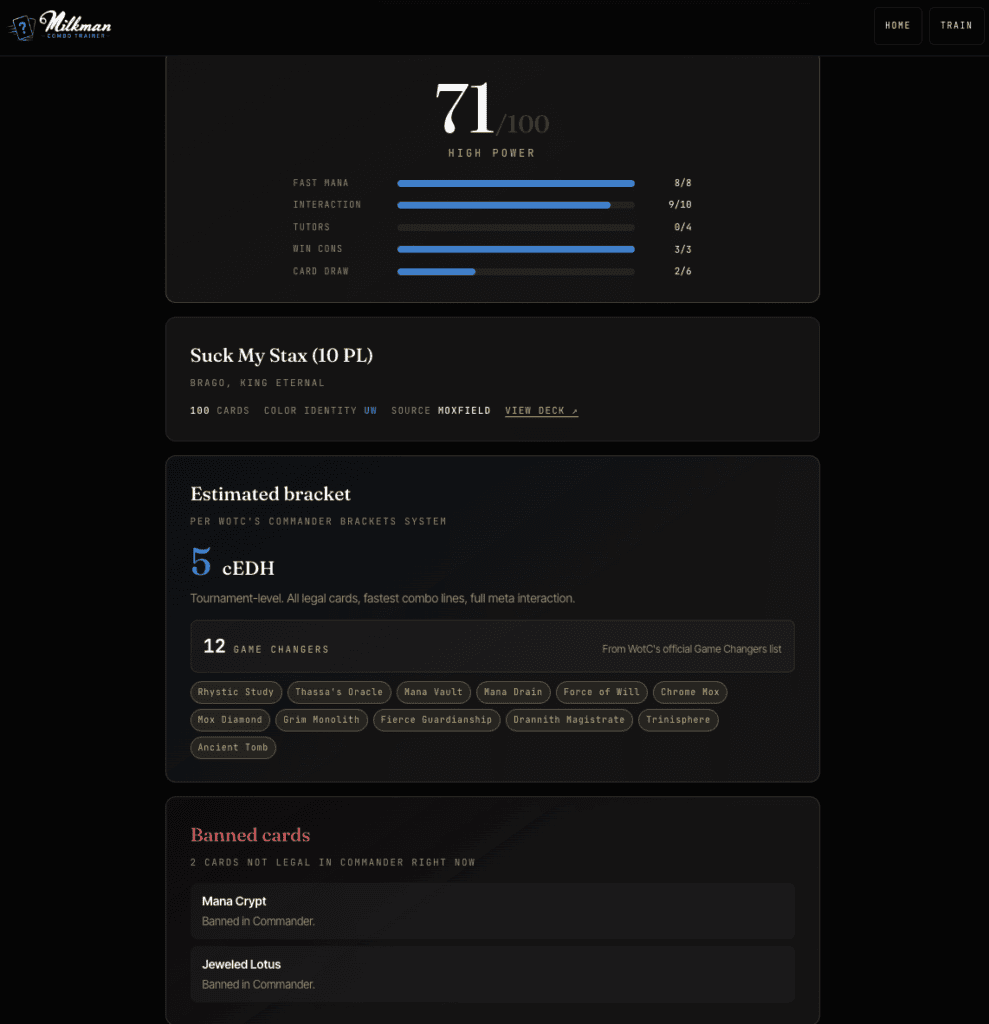
Power level signals. Average mana value, fast mana count, tutor density, free counterspell count, win condition redundancy. The numbers that actually correlate with how the deck performs against pods running Tymna/Thrasios or Kinnan.
Upgrade suggestions. Missing combo pieces, redundant tutors, slow ramp that should be cut. Specific swaps, not vague advice.
Why combo density decides your power level
A deck with one win condition is a deck with one removal spell between you and losing. A deck with three independent win lines is a deck that grinds through interaction.
This is the gap between “high-powered casual” and actual cEDH. The strongest best combo decks in cEDH carry three to five distinct win conditions — usually a primary line, a backup that shares pieces with the primary, and a gas-in-the-tank finisher for grindy games. Thoracle decks pair Demonic Consultation with Tainted Pact and Underworld Breach. Kinnan decks pair Basalt Monolith with Bloom Tender and Walking Ballista. The redundancy isn’t decoration. It’s the deck.
When you analyze your list and find one combo line, that’s a deck that wins when nothing goes wrong. When you find four, that’s a deck that wins through interaction.
How to analyze your deck in three steps
The whole process takes about a minute, and it works best if you have a current Moxfield list ready.
- Paste your decklist. Drop a Moxfield URL or copy-paste 100 card names. The parser handles either.
- Review the combo report. You’ll see every complete combo, every orphan piece (a combo half whose partner isn’t in the deck), and every legality flag.
- Apply the swaps. The tool suggests specific cuts and adds. Re-run the analysis after each change to see the score move.
The orphan piece check is the one that surprises people most. You’ll find out you’ve been running half a combo for six months because the other half got cut during a budget pass and you forgot.
The combos it will find in most cEDH-adjacent lists
If your deck is anywhere in the 7+ power range, the analyzer will probably surface a handful of these. They’re the best 2-card commander combos for a reason — cheap, tutorable, win on the spot.
| Combo | Result | Color Identity |
|---|---|---|
| Thassa’s Oracle + Demonic Consultation | Win the game | UB |
| Thassa’s Oracle + Tainted Pact | Win the game | UB |
| Isochron Scepter + Dramatic Reversal | Infinite mana (with rocks) | U |
| Heliod, Sun-Crowned + Walking Ballista | Infinite damage | W |
| Kiki-Jiki + Zealous Conscripts | Infinite hasty creatures | R |
| Mikaeus, the Unhallowed + Walking Ballista | Infinite damage | B |
| Exquisite Blood + Sanguine Bond | Win the game | WB |
| Underworld Breach + LED + Brain Freeze | Mill all opponents | UBR |
This is a comparison snapshot, not the full output. The actual analyzer surfaces every combo in your specific list and flags which ones are tutor-reachable on turn 3.
What we see working in cEDH lists right now
There’s a pattern across high-power lists submitted lately. The decks that win consistently aren’t the ones with the most combos — they’re the ones with the cleanest combo overlap.
Lists that share pieces between win lines (a single tutor finds your A-line or your B-line) outperform lists with two separate, isolated combos. Underworld Breach is the modern example: a backup win con, a graveyard refuel, and a combo enabler all at once. One card, three jobs. That’s what tightening looks like at the top end of the format.
The opposite mistake is also common — decks running infinite mana combos in commander with no payoff. Infinite mana that doesn’t kill is just a long turn. If your list goes infinite and the only outlet is “cast my commander four times,” that’s a flag.
Common mistakes that kill combo consistency
A few patterns show up in nearly every list submitted to the analyzer that scores below a 7.
- Orphan combo pieces. Half a combo with no partner and no standalone value. Cut it or add the partner.
- Tutor-resistant combos. Combos that need cards across multiple types when your tutors only find creatures.
- Slow combo enablers. Three-mana ramp, four-mana tutors. The combo is fine; the supporting cast is the problem.
- Color identity violations. A hybrid mana symbol that pulled in a third color you didn’t notice.
- Banned cards. Mana Crypt and Jeweled Lotus aren’t legal anymore. Hullbreacher’s been gone for years. Old primers still list them.
The analyzer flags every one of these on the first pass. You can ignore them or fix them, but you can’t say you didn’t know.
A real-world example
A Krenko Mob Boss player ran their list through the analyzer last week expecting to find three combo lines. The report showed two — Kiki-Jiki + Zealous Conscripts, and Splinter Twin + Conscripts — plus an orphan Goblin Recruiter with no Conspicuous Snoop in the deck. The Snoop had been cut during a price-conscious rebuild, and the Recruiter, which existed entirely to enable the Snoop loop, got left behind.
Time to find the gap: about eight seconds. Time it would have taken in playtesting: probably another month of pods.
Why this matters more in 2026
Commander Spellbook tracks over 30,000 combo variants across the format. The legality landscape shifts every banlist update. Sets like Lorwyn Eclipsed and Secrets of Strixhaven add cards every few months that quietly enable combos you weren’t tracking.
A static decklist is a deck that gets worse over time. The analyzer pulls live data, so the report reflects the current banlist, the current set legality, and the current combo database — not what was true the last time you read a primer.
Track your combos as you tune
Once you’ve cleaned up a list, the next move is keeping it tight as you iterate. The combo trainer pairs with the analyzer — you can save and track your commander combos per deck, then drill yourself on the lines so you actually recognize them at the table when an opponent assembles one.
This is where most players leak power. They build a strong list, analyze it once, then never look at it again. Six months later they’re playing the same 99 with three new bans applied and four cards from new sets that should have been swapped in.
Test before you buy
The other reason this workflow exists is that good Commander testing is expensive. A clean cEDH list runs $3,000+ in real cards. MTG Proxy Cards exists for the part of the process before you spend that money. Proxy the deck, run it through the analyzer, drill the combos in the trainer, and play it in your local pod for a month before deciding whether the list is the one. Then order the real versions of the cards you actually kept.
That’s the order of operations: analyze, train, playtest, then buy. Building expensive in any other order is how people end up with $400 worth of cards that came out of the deck three weeks later.
Frequently asked questions
Is the combo analyzer free? Yes. Pasting a decklist and getting the combo report costs nothing. Premium features like saved deck history, multi-deck tracking, and full combo trainer drilling sessions are paid, but the analyzer itself is free.
Does it work for casual Commander or only cEDH? Both. The combo database covers everything from precon-level kills to tier-1 cEDH lines. Power level scoring is calibrated for cEDH, but a casual deck just gets a lower number — the combo identification works the same.
What if my deck has a combo it doesn’t recognize? The analyzer pulls from Commander Spellbook, which is community-maintained and includes effectively every known combo. If something is missing, it’s either a homebrew interaction or hasn’t been submitted yet. You can submit new combos to Spellbook directly, and they’ll show up in the analyzer once verified.
Can I use this with a Moxfield import? Yes. Paste a Moxfield URL or export the list as plain text. Both work. The parser handles standard formats automatically.
Stop guessing what’s in your deck
You don’t need a coach. You don’t need another primer. You need a tool that reads your decklist, tells you what it actually does, and shows you what’s missing.
That’s what the analyzer is.
Run your decklist through the analyzer →
Free. Ten seconds. Every combo in your 99, surfaced.